
What If You Could Explore
Intense Emotions Without Using Your Own Pain
Watch The EDP Experience
Discover the Emotional
Distancing Phenomenon
a body-based approach to creating
emotionally truthful characters while
maintaining a clear distinction between
actor and role


WHAT IS EDP?
EDP is a body-based approach that helps actors access authentic emotion without deliberately mining personal pain. Through physical transformation and imagery, emotion can emerge from the character’s constructed body rather than the actor’s autobiographical experience.
BUT WHAT DOES IT FEEL LIKE TO THE ACTOR?
The character feels.
The actor observes
WHAT IF THE EMOTION BELONGED
TO THE CHARACTER - NOT TO YOU?
EDP guides the actor through physical transformation and imagery so emotions arise from the character rather then personal memory
FIRST-TIME ACTOR. 30+ YEARS OF EXPERIENCE.
ONE SCENE. SAME EMOTIONAL FREEDOM
CAN THE CHARACTER
BE IN
PAIN
while the actor is
BLISS
IN
?
The character lives the emotion.
The actor experiences the joy of creating it.
WHAT BECOMES POSSIBLE
WHEN YOU STOP CHASING EMOTION?
More freedom. More spontaneity. More presence.
Without forcing yourself to feel.

BE PRESENT
Respond to your partner instead of managing your emotions.

BE FREE
Let emotion emerge without forcing, manufacturing, or reliving it.

BE AVAILABLE
Stay open to what happens in the scene — differently, every time.
YOU DON’T HAVE TO REACH FOR EMOTION.
YOU HAVE TO MAKE YOURSELF AVAILABLE TO IT
EDP ENTERS THE LAB
After more than three decades of observation in actors, EDP is moving from the rehearsal room into scientific investigation.
CAN THE BODY CREATE THE CHARACTER’S SUBJECTIVE EXPERIENCE?
THE HYPOTHESIS
IMAGERY → BODY → EMOTION
Structured mental imagery reorganizes the actor’s body.
The altered body changes the information available to the brain.
Emotional experience may then emerge from the character’s embodied state.
What began as an acting technique evolved into a hypothesis that drew the interest of neuroscientist Antonio Damasio.

ANTÓNIO DAMÁSIO
Neuroscientist · Brain and Creativity Institute

GULU MONTEIRO
Creator of Emotional Distancing Phenomenon (EDP)
And It Can Be Tested

BRAIN
fMRI · EEG


BODY
Heart rate · Skin conductance · Respiratio
EXPERIENCE
Movement analysis · Structured subjective reports
FROM AN ACTING TECHNIQUE TO A QUESTION ABOUT HUMAN CONSCIOUSNESS
WHAT IF YOU COULD
EXPERIENCE IT FOR YOURSELF?
EDP isn’t something you understand intellectually.
It’s something you experience in your body.


IMAGINE → TRANSFORM → DISCOVER
A glimpse inside the EDP process
DON’T TRY TO FEEL
THE CHARACTER.
CREATE THE CONDITIONS —
AND LET THE EXPERIENCE EMERGE.
THE EDP WORKSHOP
EXPERIENCE EDP IN PRACTICE
A hands-on workshop where actors explore character transformation through imagery, physical organization, perception and play — without forcing emotion or relying on personal emotional memory.
WHAT YOU’LL EXPLORE


IMAGERY
Character construction
through imagery
WHO IT’S FOR
From actors beginning their training to
experienced professionals.

SCENE
Scene workand interaction
PLAY
Improvisation
EMOTION
Emotional
emergence
PERCEPTION
Character-based
perception
BODY
Physical
transformation
READY TO EXPERIENCE EDP?
EDP training is currently offered exclusively online, making it possible to work together wherever you are.


ONLINE GROUP WORKSHOPS
PRIVATE ONLINE SESSIONS
ROLE PREPARATION
Experience the EDP process with other actors through guided physical exploration, character work and scene practice.
Work one-on-one with Gulu, with the process tailored to your training, a specific character, or your individual needs.
For Film, Television & Theatre
Individual coaching for actors preparing a specific role — using EDP to explore the character’s body, perception, behavior and emotional life while responding to the particular demands of the script and production.
Private sessions are offered in English, French and Portuguese. Group workshops are currently held in English.
FIND THE RIGHT FORMAT FOR YOU
Complete the form to receive information about available programs, schedules and pricing. There’s no commitment — just tell us what you’re interested in, and we’ll send you the options.
Big Title
Big Title
WHAT IS AN EMOTION
Emotion and feeling are often used as if they meant the same thing. In neuroscience, however, they refer to different aspects of the same process.
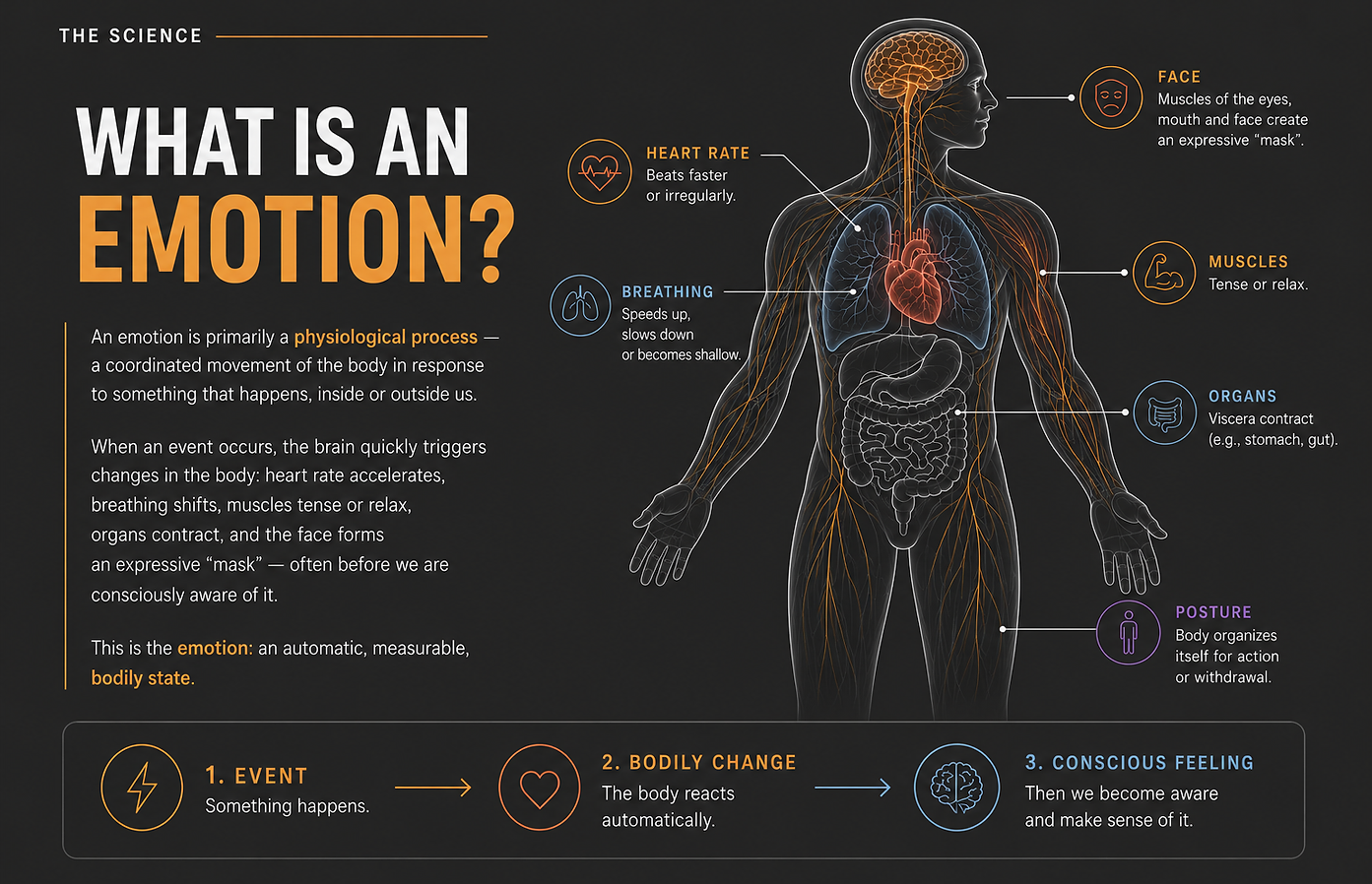
According to neuroscientist Antonio Damasio, emotions involve coordinated changes throughout the body. Changes in posture, muscle activity, breathing, heart rate, hormones — patterns that prepare the organism to respond to a situation.
Feelings, by contrast, are the conscious experience of those bodily changes. To put it simply: emotion is the body's response, feeling is the experience of that response.
Understanding this distinction is a first step toward exploring how emotion may emerge in performance
EMOTION COMES BEFORE FEELING
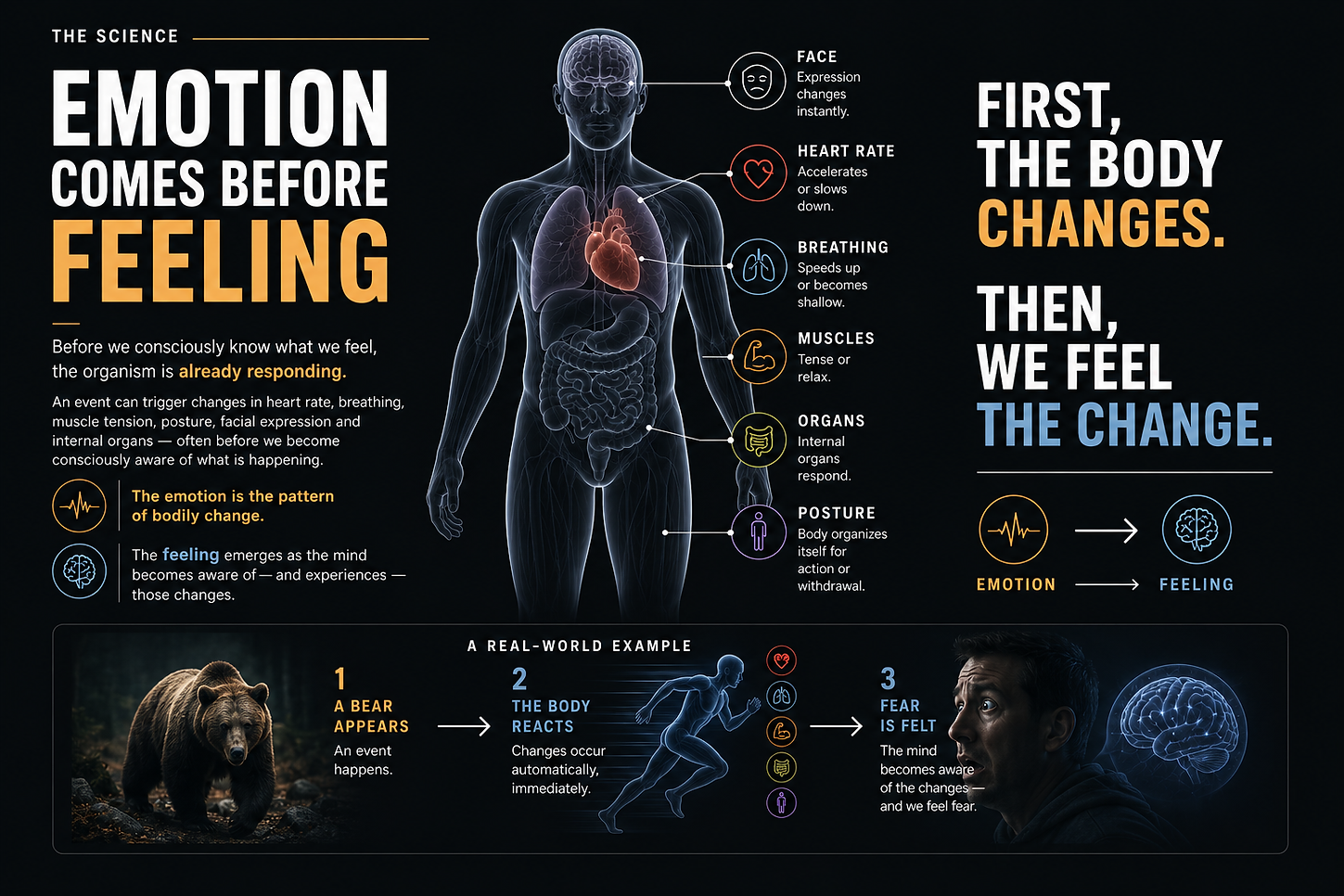
Before we consciously know what we feel, the organism is already responding.
An event can trigger changes in heart rate, breathing, muscle tension, posture, facial expression and internal organs — often before we become consciously aware of what is happening.
The emotion is the pattern of bodily change.
The feeling emerges as the mind becomes aware of — and experiences — those changes.
FIRST, THE BODY CHANGES.
THEN, WE FEEL THE CHANGE.
THE BODY AND BRAIN:
A TWO-WAY CONVERSATION
FROM WILLIAM JAMES TO ANTONIO DAMASIO
The brain does not simply command the body.
The body is constantly informing the brain.
Every change in posture, muscle tension, breathing, heart rate and internal state sends information back through the nervous system.
The brain continuously maps these changes, contributing to the moment-to-moment experience of the organism.
BODY → BRAIN → BODY → BRAIN
It is a continuous loop.
James suggested that bodily changes are not merely the result of emotion. Our perception of those changes is part of what gives rise to feeling.
In the late nineteenth century, William James proposed a provocative reversal of the usual idea of emotion:
Do we run from the bear because we are afraid — or are we afraid because we run?
More than a century later, Antonio Damasio developed a contemporary neuroscientific account in which the continuous mapping of the body by the brain plays a fundamental role in feeling and consciousness.
THE BODY DOESN’T JUST EXPRESS WHAT WE FEEL
IT PARTICIPATES IN CREATING WHAT WE FEEL

THE BODY-MIND TRANSFORMATION
THE PHENOMENON EXPLAINED
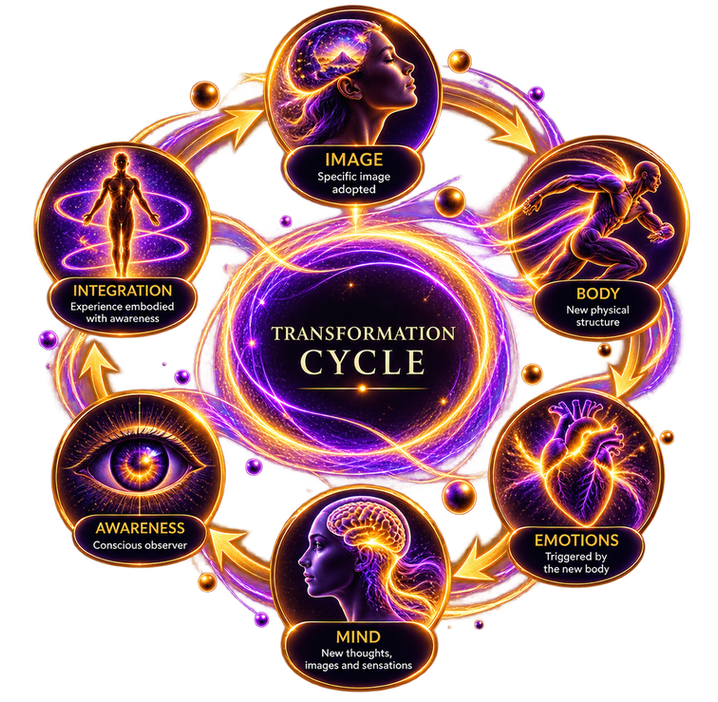
A specific image shapes the body. The body shapes the mind.
This is how transformation on stage becomes real.
THE PHENOMENON





1. IMAGE
2. BODY
TRANSFORMATION
3. INFORMATION
FLOW
4. EMOTIONAL
TRIGGER
The actor adopts a specific image—an animal, an element of nature, and three psychological characteristics.
The body adjusts, creating a new physical structure based on each image.
The altered body sends new information
to the mind through the nervous system.
Emotions and feelings are triggered in response to the reality created by this new bodily posture.
5. NEW MIND
6. OBSERVER
AWARENESS
Thoughts, images and sensations
arise in alignment with the new body’s constitution.
The actor recognizes: “This is not me.”
A conscious distance emerges.
The actor becomes a privileged observer of the character’s truthful emotional life
THE THEORY
A specific image influences the body, creating a new physical structure.
This new body communicates different information to the mind.
Emotions and feelings are triggered in alignment with this new physical reality.
Thoughts, images and sensations that arise are relative to that body — the character.
The actor experiences a conscious distance, observing the experience as the character lives it through.
The body provides everything needed, and the actor becomes a privileged witness to the character’s truth.
MEET YOUR INSTRUCTOR
GULU MONTEIRO
Director. Educator. Creator of EDP.
Gulu Monteiro is an award-winning theatre, opera and film director, acting professor, and the creator of the Emotional Distancing Phenomenon (EDP).
For more than four decades, his work with actors has explored a fundamental question: How can an actor experience the emotional life of a character fully — without having to use their own personal emotional history to create it?

That question became a lifelong investigation — developed in rehearsal rooms, classrooms and productions across the United States, Europe and Brazil — and ultimately evolved into EDP.
FROM THE STAGE TO THE CLASSROOM
Gulu’s directing work has been presented by institutions including the Getty Villa, LA Opera, The Broad Stage and the Centre Pompidou, with productions receiving Ovation Award, LA Weekly Award and Maddy Award honors.
40+ YEARS
Working with actors
USC
School of Dramatic Arts
UCLA 8 years ·
School of Theater, Film and Television
UCLA 8 years · School of Theater, Film and Television
PARIS
L’École du Jeu


A LIFELONG INVESTIGATION
EDP was not conceived as a theory and then applied to actors.
It emerged from actors themselves
Through decades of observation, experimentation and practice, Gulu began to recognize a recurring phenomenon: when the actor’s physical organization changed through carefully structured imagery, perception changed with it — and thoughts, impulses and emotions could begin to emerge without being deliberately manufactured.
The actor could experience the character intensely while remaining aware:
This belongs to the character.
It does not have to belong to me.
That discovery became the foundation of Emotional Distancing Phenomenon.
TODAY, THE INVESTIGATION CONTINUES
From professional productions and conservatory classrooms to the emerging scientific investigation of EDP, the question remains the same:
WHAT BECOMES POSSIBLE WHEN THE ACTOR STOPS TRYING TO FEEL — AND ALLOWS THE CHARACTER TO LIVE?
WHAT ACTORS EXPERIENCE
EDP is not only something actors learn.
It is something they discover through experience.
American Actors
French Actors
Brazilians Actors
Industry Testimonials
“Gulu uses actors in a wonderful way. The commitment to the characters’ intentions is so high, and the stakes are so high, there’s no time to think. They’re just busy doing.”
— Larry Moss, Acting Coach

"Amazing how the cast could play two roles at the same time and commit fully to both characters... completely transform themselves and become a completely unrecognizable person."
— Kathryn Morris (American Film Star)

"Gulu works by encouraging the actor to stimulate their creativity, discovering the character through the body and not letting the rational interfere in the process. It is a valuable immersion experience conducted with great sensitivity."
— Rodrigo Santoro (International Film Star)

"Gulu's work is amazing. At each stage of his work, the actor experiences, as in life, a constantly renewed creation of his actions and feelings, while being aware that he is still playing."
— Brigitte Fossey (International Film Star)

"This kind of movement theatre that Gulu does, I haven't seen before. It's really, really good"
— Jacqueline Bisset (International Film Star)

“It provides a lot of freedom as an actor to really explore, go beyond what you might do if you're just there as yourself.”
Tobey Maguire (Film Star and Producer)

WHAT THEY SAY ABOUT GULU’S FIRST PRODUCTION IN LA
Leonardo DiCaprio, Tobey Maguire, Jacqueline Bisset, Katherine Morris and Larry Moss reflect on their experience of seeing Gulu’s first production in Los Angeles.
“FEELINGS ARE THE RESULT OF ACTIVE DOING.”
— Sanford Meisner